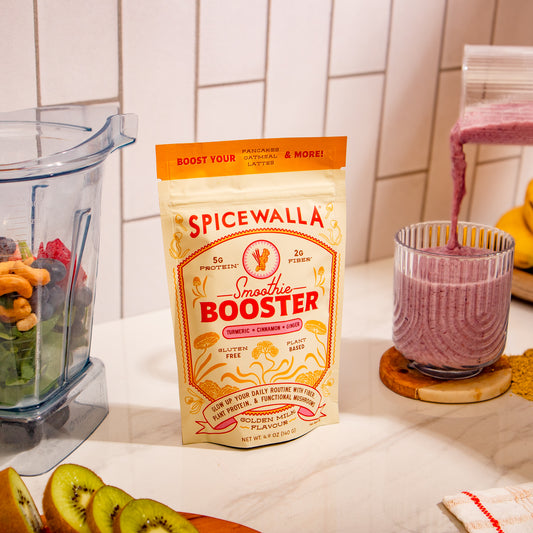
When people see "seven organic mushrooms" on our Smoothie Booster bag, the first question is almost always: which ones? The second is usually: wait, what does that taste like?
Good news on the second one. You won't taste a mushroom-y smoothie. In the blend, the mushrooms add a quiet, earthy depth that plays nicely with turmeric, cinnamon, and ginger. And as you’d expect, the spices are the stars ✨
As for the first question, here's who's in the bag. Every one of them is certified organic, and every one has a story worth knowing.
Shiitake
If you've cooked with mushrooms, you've probably cooked with shiitake. Native to East Asia, it's one of the most popular mushrooms in the world, with a deep, savory flavour that makes ramen, stir-fries, and miso soup taste like more.
Dried shiitake is one of the classic sources of natural umami in Japanese and Chinese cooking.
Maitake
Maitake means "dancing mushroom" in Japanese. Here in the US, foragers call it hen of the woods, because its big, frilly clusters look a little like a ruffled hen sitting at the base of an oak tree. Roast a fresh one in a hot oven, and the edges turn crisp and almost meaty.
Lion's Mane
Shaggy, white, and shaped like a pom-pom (or a lion's mane, if you squint). When it's cooked fresh, chefs love lion's mane for its texture, which is often compared to crab or lobster.
In Japan, it's called yamabushitake, named for the yamabushi, mountain-dwelling monks whose robes had shaggy pom-pom tassels that look a lot like it.
Turkey Tail
If you've ever walked through the woods here in the Blue Ridge, you've almost certainly stepped past turkey tail. It grows in thin, fan-shaped layers on fallen hardwood, striped in browns and tans like a turkey's tail feathers. It's too tough to eat whole, so it's traditionally brewed.
Chaga
Chaga doesn't look like a mushroom at all. It grows as a dark, crusty, almost charcoal-looking lump on birch trees in cold northern forests, from Russia and Scandinavia to Canada and the northern US. People in those regions have brewed it into a dark, earthy tea for centuries.
Cordyceps
Slender, orange, and finger-shaped. Its most famous wild form comes from the high Tibetan plateau, where it has long been prized and expensive. Today, most cordyceps is cultivated, which makes it far more accessible.
Red Reishi
Shiny, reddish-brown, and woody, reishi is too tough to eat, so it's dried and brewed instead. In Chinese, it's called lingzhi, and for centuries it has shown up in Chinese art as a symbol of good fortune and long life, painted on scrolls and carved into jade and wood. It has a famously bitter taste on its own, which is one more reason we're glad it's sharing the stage with cinnamon.
Why "Extract" for Some and Not Others?
Take a peek at the ingredient list, and you'll see some mushrooms listed as mushroom and others as mushroom extract.
Shiitake, maitake, and reishi are used as whole mushroom powder.
Lion's mane, chaga, turkey tail, and cordyceps are extracts, a concentrated powder that's made by steeping the mushroom, a lot like brewing a very strong tea, and drying what's left. A little organic maltodextrin helps keep those extracts a fine, even powder (instead of clumping into a ball).
Where They Meet Golden Milk
Put these seven together with turmeric, cinnamon, ginger, and black pepper, add fava bean protein, and you get Smoothie Booster!
5 grams of plant protein and 2 grams of fiber in every 2 tablespoons, ready to stir into your smoothie, latte, oatmeal, or pancake batter!
This is not medical advice. We're a spice company, not medical experts. Please do your own research and talk with your doctor or healthcare team before adding anything new to your routine.