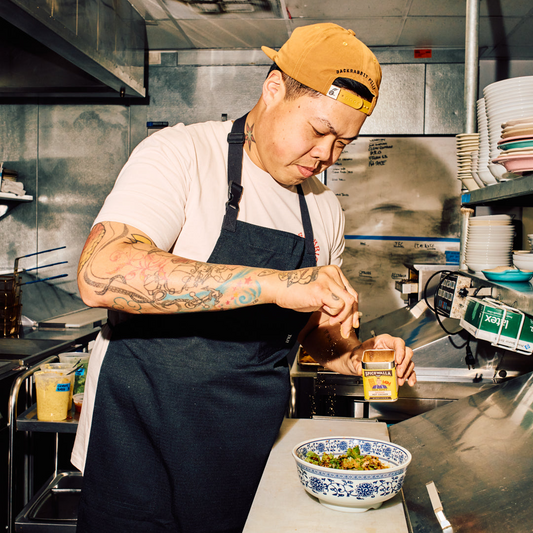
There’s a certain kind of chef who thinks about spice the way we do: not as a heat level, but as a thread back to somewhere real.
Chef Shuai Wang is that chef.
The James Beard-nominated chef and co-owner of Jackrabbit Filly and King BBQ in North Charleston has spent his career cooking Chinese culinary traditions into food that people in the American South have fallen completely in love with.
When he sat down with us to talk about what a collaboration could look like, this blend came into focus fast.

The Sichuan Hot Chicken Spice
The Sichuan Hot Chicken Spice started with a specific memory: the cumin lamb skewers Shuai grew up eating in Beijing, and the hot pot dry dipping mixes that are a staple of Chinese cooking. Both of those traditions are alive in this blend.
We sat down with Shuai to hear the story behind the blend in his own words.
"When me & Corrie had the food truck, and we landed on the hot chicken bowl, I was just using togarashi...okay, it’s spicy enough, it imitates that hot chicken flavour. And then we took a trip to Beijing, right before the pandemic. My uncle took us to this trout farm about an hour outside the city. All Sichuan-style food. You fish out the trout yourself, they grill it, and then they just douse it in Chinese-style chilli powder and tons of cumin. I’d never had charred fish seasoned that heavily with spices like that before.
Coming up through culinary school, you learn about cooking fish, and you want delicate flavours...you never think about putting all these heavy flavours on it. So that was really inspiring.
And then eating hot pot in China with my parents. Some people dip in the sesame paste sauce with cilantro and all that, but a big part of eating hot pot in Beijing is dipping in dry spice: chili powder and cumin. Which is actually the same spice they use on cumin lamb skewers, which I also grew up eating.
All these different inspirations from trips and visits in Beijing kind of changed our formula for our hot chicken. So instead of just using straight togarashi, we started making our own blend that tasted like that hot pot dry spice...and all of a sudden it went from Japanese-inspired chicken to something that was really mine."
And damn, did he hit gold! The Spicewalla team has been pretty obsessed with this blend (receipt here).
What’s Inside and Why it Works

The Heat Foundation: Red, White & Black Pepper
Red pepper (cayenne) hits first and fast.
Black pepper is earthier and more pungent, building heat in the back of the throat.
White pepper is subtler still, with a slightly fermented depth that shows up throughout Chinese cooking in ways you might not notice until it’s missing.
Stacking all three isn’t just a flavour decision; each one contributes a different moment in the heat timeline, so you’re tasting through the blend rather than just into it.
The Aromatic Warmth: Cumin, Coriander & Fennel
Cumin is the soul of Beijing street food. It’s what makes cumin lamb skewers taste like a memory even if you’ve never been to Beijing, and it’s the spice Shuai grew up eating on the street.
Coriander seed (not the leaf) adds a bright, citrusy lift that keeps the warmth from getting too heavy. Fennel brings a gentle anise-like sweetness underneath it all.
Together, they’re why this blend smells like somewhere specific.
The Warm Depth: Cinnamon, Clove & Star Anise
Cinnamon, clove, and star anise are three of the five ingredients in Chinese five spice, a combination so foundational to Chinese cooking that it shows up in braises, marinades, and slow-cooked dishes across every region.
In this blend, they don’t read as sweet or dessert-adjacent. They’re the warm, slightly mysterious background note that makes you keep eating to figure out what it is. Star anise in particular adds a deep liquorice-like warmth, sweetness without any sugar, and a complexity that’s hard to put your finger on but impossible to miss.
The Electric Finish: Sichuan Peppercorns
If you haven’t cooked with Sichuan peppercorns before, here’s what to know: they’re not really pepper at all. They’re the dried husks of the prickly ash plant, and they produce a sensation unlike anything else in the spice world.
The Chinese call it má, the numbing quality in má là, the numbing-spicy combination that defines so much of Sichuan cooking. After eating Sichuan peppercorns, your mouth and tongue will be buzzing and tingling. The food goes electric rather than just hot. This blend captures that completely.
One more thing worth knowing: this blend is vegan. That savory, umami-packed depth comes from a vegan chicken-flavoured powder, which is why it works just as well on roasted vegetables and fries as it does on actual chicken.
 At Jackrabbit Filly, Shuai’s karaage gets dipped in chilli oil and then dredged in this mix for an umami-packed hot chicken that people come back for again and again.
At home, it works as a hot pot dipping blend, a dry rub for lamb, chicken, trout, or venison, shaken over fries and roasted vegetables, or mixed into butter and brushed over corn. As Shuai puts it: “anything you’d put salt on can get this blend.”
Try it in these recipes & get ready to fall in love:
Shuai Wang’s Mapo Tofu

Sichuan Hot Chicken Cheez-Its

A Blend That’s Really His
What started on a food truck with a bag of togarashi ended up here: a blend rooted in Beijing street food, a trout farm an hour outside the city, and the kind of hot pot dipping ritual that’s been part of Chinese cooking for generations.
Shuai didn’t set out to make a hot chicken spice. He set out to make something that tasted like home, and that’s exactly what this is. And bringing that into your kitchen is exactly why Spicewalla is here!