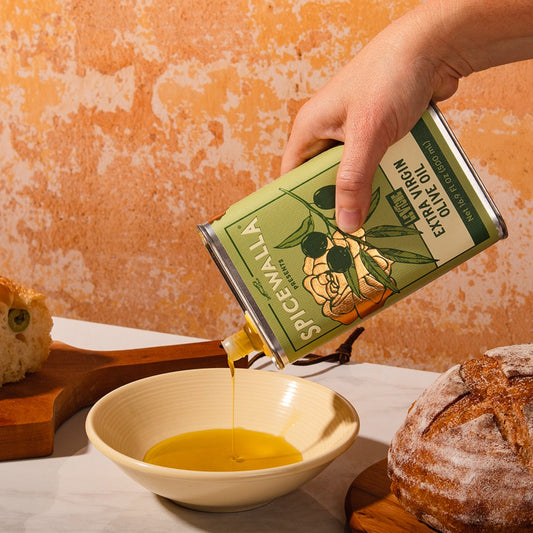
Curious about what makes an extra virgin olive oil truly exceptional? Or maybe you’ve wondered how to get the most flavour from a drizzle or a roast?
We’ve gathered the questions we get asked most often about extra virgin olive oil, from harvest to storage. Cook smarter and enjoy every drop of Spicewalla x Le Vigne Extra Virgin Olive Oil!

Your EVOO Questions, Answered!
We hear these questions all the time...at markets, in emails, in our DMs at 9 pm when someone's standing in the kitchen trying to decide which olive oil to reach for.
So we figured it was finally time to put all the answers in one place! Pull up a chair. Let's talk olive oil.
What makes extra virgin olive oil “extra virgin”?
Extra virgin olive oil (EVOO) is the highest quality olive oil, made by cold-pressing olives without heat or chemicals. It must meet strict chemical and sensory standards, including low acidity (under 0.8%) and no sensory defects. That’s what gives it that fresh, grassy, peppery bite you can actually taste.
Why are polyphenols important in olive oil?
Polyphenols are powerful antioxidants naturally found in olives. They give high-quality oils their peppery finish (that little tickle in your throat!) and help protect the oil from oxidation, keeping it fresh longer.
What does “early harvest” mean?
Early harvest olive oil is made from olives picked while still green, before they fully ripen. That means fewer drops of oil per olive, but way more concentrated flavour, antioxidants, and those spicy, grassy notes chefs love.
Le Vigne is harvested early in the season, when olives are still green, and polyphenol content is at its peak. The result is an oil that is not only flavourful but also rich in healthy compounds!
The polyphenol levels come in at 584 mg/kg. Oils above 300 mg/kg are considered high-polyphenol; this is nearly double!
Lab testing also confirms that Le Vigne meets the strict standards for extra virgin classification, with free acidity below 0.8% and peroxide value well below the 20 meq/kg threshold.
How should I store olive oil?
Keep your olive oil in a cool, dark place away from heat and light. A pantry or cupboard is perfect! Once opened, try to use it within 3–6 months for peak flavour.
What’s the difference between olive oil from Italy, Spain, and Greece?
Each region produces distinct flavour profiles based on olive varieties and climate. Italian oils, like Le Vigne, tend to be bold and balanced with grassy, artichoke-like notes; Spanish oils are often smooth and nutty; Greek oils are typically robust and peppery.
Can I cook with extra virgin olive oil?
Absolutely. Despite myths that you can’t, high-quality EVOO has a relatively high smoke point (around 375°F), which is perfect for roasting, sautéing, or finishing. The key is to use it where its flavour can shine, not hide.
What does “cold-pressed” mean?
“Cold-pressed” means the oil was extracted without heat or solvents, preserving its nutrients, aroma, and fresh olive taste. It’s all about gentle pressure — not high heat.
How can I tell if my olive oil is real or fake?
Look for transparency: single-estate origin, harvest date, and lab testing details (like acidity and peroxide levels). If an olive oil lists all that, like Le Vigne, you can trust it’s the real deal.
What's the difference between a harvest date and a best-by date?
These are not the same thing, and the harvest date is the one that actually matters.
The best-by date tells you when the oil is safe to consume. It can be set as far out as two years from bottling, which doesn't tell you much about freshness.
The harvest date tells you when the olives were picked and pressed. For peak flavour and polyphenol content, you want to be using your oil within 12–18 months of that date.
If a bottle doesn't show a harvest date at all, that's worth noticing.
Does bottle color actually matter?
It does, more than most people realize!
Light is one of the fastest ways to degrade olive oil. It breaks down those polyphenols and good fats and accelerates oxidation. That's why high-quality EVOO comes in dark glass or opaque packaging (or a metal tin, like ours 🙂).
If you've ever bought olive oil in a clear bottle off a brightly lit grocery shelf, there's a real chance the quality was already compromised before you even opened it. Store yours in a dark cupboard, and you're most of the way there.
How do I know if my olive oil has gone bad?
Fresh, high-quality EVOO smells grassy, fruity, and faintly peppery.
When it's gone rancid, it smells waxy, stale, or like old crayons...sometimes like a musty basement or nuts that have been sitting too long. If you taste it and it's flat with no bite, that's another sign it's past its prime. Rancid oil won't hurt you, but it also won't do anything good for your cooking. When in doubt, trust your nose, friends!